Sales teams operate in an era of information that randomly creates visibility gaps. Organizations are increasingly exploring AI as the solution to bridge these gaps. The objective isn't to replace existing CRM systems but to enable teams to work smarter with less friction. When deployed thoughtfully, AI acts as an intelligent partner that interprets data, anticipates needs, and supports better decision-making.

CRMs store customer data, and AI can help identify patterns within it. Together, they reveal insights that normally humans would miss on their own. For sales leaders, the question isn't "Should we use AI?" It's "How do we add this without disrupting our team or adding more complex tools?"
Most sales organizations share common challenges: accurately forecasting revenue, prioritizing leads effectively, reducing response times, personalizing customer conversations, and minimizing manual data entry. AI addresses each need by monitoring patterns, extracting key details, and suggesting next steps. It handles the heavy lifting while sales professionals can focus on relationship building.
Industry research consistently shows that sales representatives spend roughly 30 percent of their time on non-selling activities, ie, data entry, information retrieval, and administrative updates. Every hour updating fields manually or searching for customer context is an hour not spent advancing deals or deepening relationships.
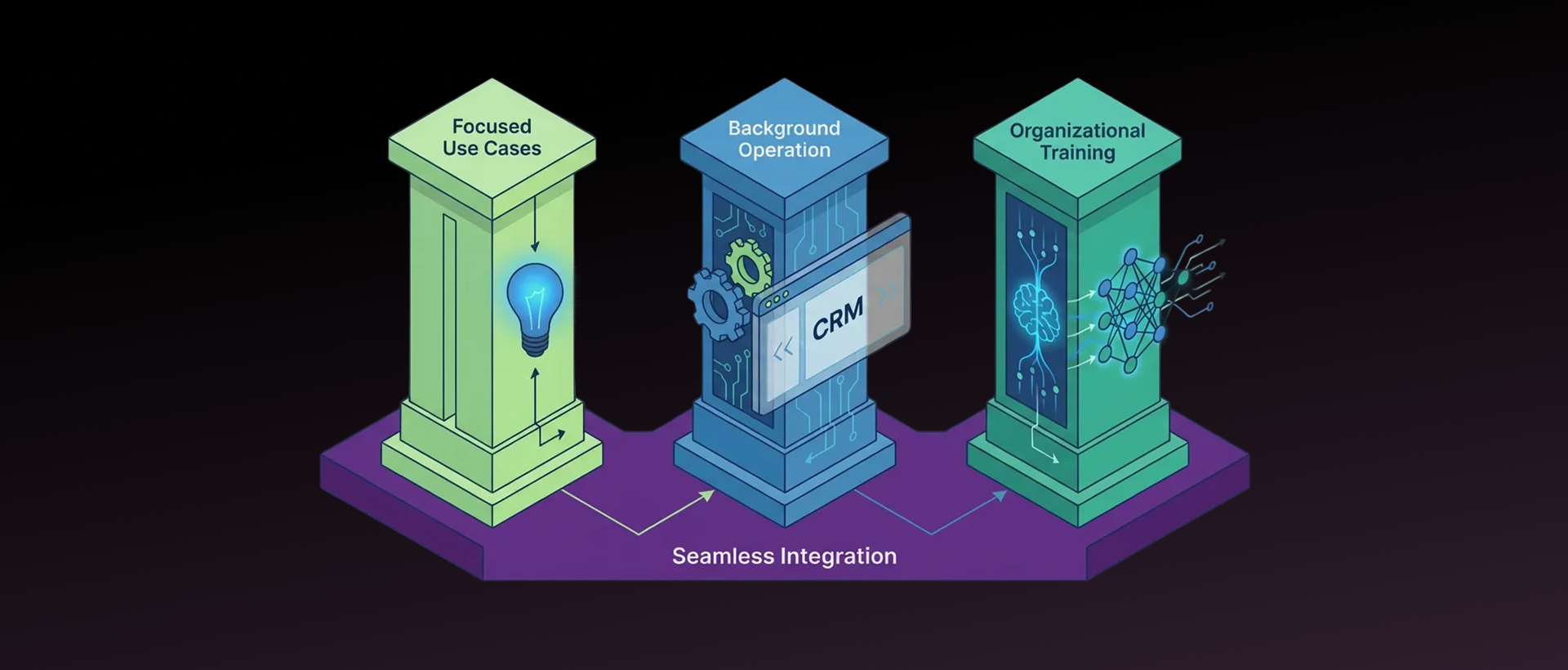
Salespeople won't use tools that make their job harder. If the tool requires to learn new processes, they'll avoid it - no matter how good the technology is. The best approach is to add AI to the tools they already use instead of replacing them. Here are the key principles:
Start with focused use cases. Organizations that attempt comprehensive AI deployment simultaneously often overwhelm teams. Beginning with a single, high-impact application, automated call summarization or predictive lead scoring, for instance, demonstrates value quickly. Success with initial use cases creates momentum for broader adoption.
Keep AI operating in the background. The best integrations work automatically. AI can monitor interactions and update CRM fields without any user input. For example, a conversation about budget constraints triggers an update to the budget field. A discussion of implementation timelines adjusts the expected close date. In the end, the system feels supportive rather than demanding.
Train systems on organizational data. Generic AI models lack context specific to an organization's customer base, sales, and terminology. Feeding previous data helps AI recommendations feel relevant rather than generic. Over time, the system learns what works in a particular business environment.
When AI handles routine tasks, representatives can shift attention towards other meaningful activities. Several improvements often appear quickly:
Better lead quality and prioritization. AI ranks prospects based on conversion likelihood by analyzing historical data, including company size, industry, engagement patterns, and previous interactions. This data-driven approach helps representatives to focus their time on activities that generate the highest return.
Faster customer conversations. AI-generated summaries provide instant context before customer interactions. Instead of scrolling through history, representatives begin with a complete understanding of recent interactions and usage patterns.
Forecasts with fewer assumptions. AI examines more data than manual reporting could process. While uncertainty remains natural in forecasting, AI-enhanced models reduce the variability that undermines planning and resource allocation.
Not everyone welcomes AI integration enthusiastically. Some worry about job security as automation takes over tasks previously performed by humans. Others question whether algorithmic recommendations understand the significance that matters in specific customer relationships. These concerns deserve direct acknowledgment.
Three principles help AI adoption feel safer and more productive.
• First, human judgment remains central, with AI suggesting rather than commanding.
• Second, transparency builds confidence. People work better when they understand how predictions form and what data informs recommendations.
• Third, ethical handling of customer data is non-negotiable, with privacy guiding every decision.
As one noted at a recent industry conference, "The winners will be those who don't treat tech as a cost center but as a performance multiplier." That perspective requires viewing AI not as a replacement for human expertise but as an amplifier of it
.
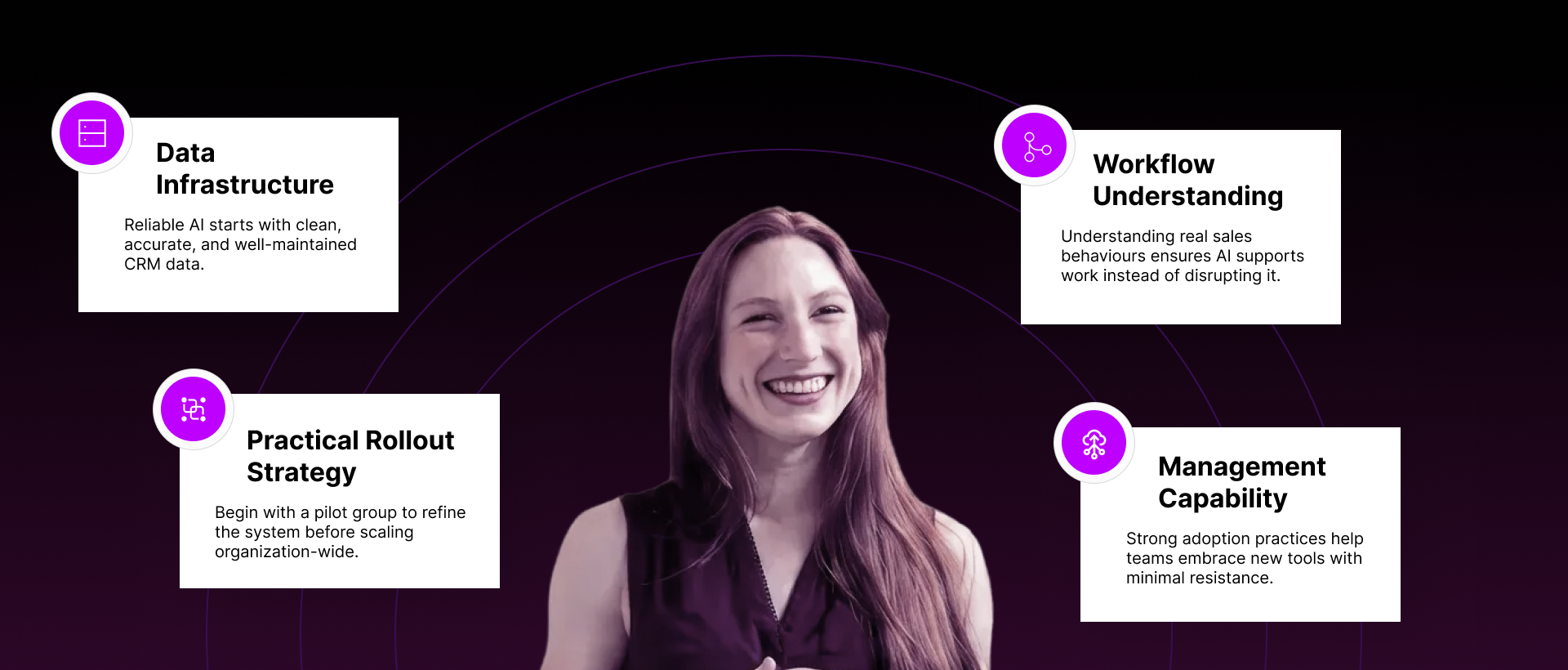
The evolution of AI capabilities within CRM systems represents not just a temporary trend but a fundamental shift in how sales operate. Pattern recognition, automated insight generation, and intelligent assistance will increasingly become standard expectations.
The opportunity is clear. Success requires combining technological sophistication with careful attention to adoption and continuous refinement. Organizations that achieve this balance create sustainable competitive advantage: not by choosing between human expertise and AI capability, but by strategically combining both
.svg)
we partner with ambitious teams to solve real problems, ship better products, and drive lasting results.
Read more Case Studies & Insights